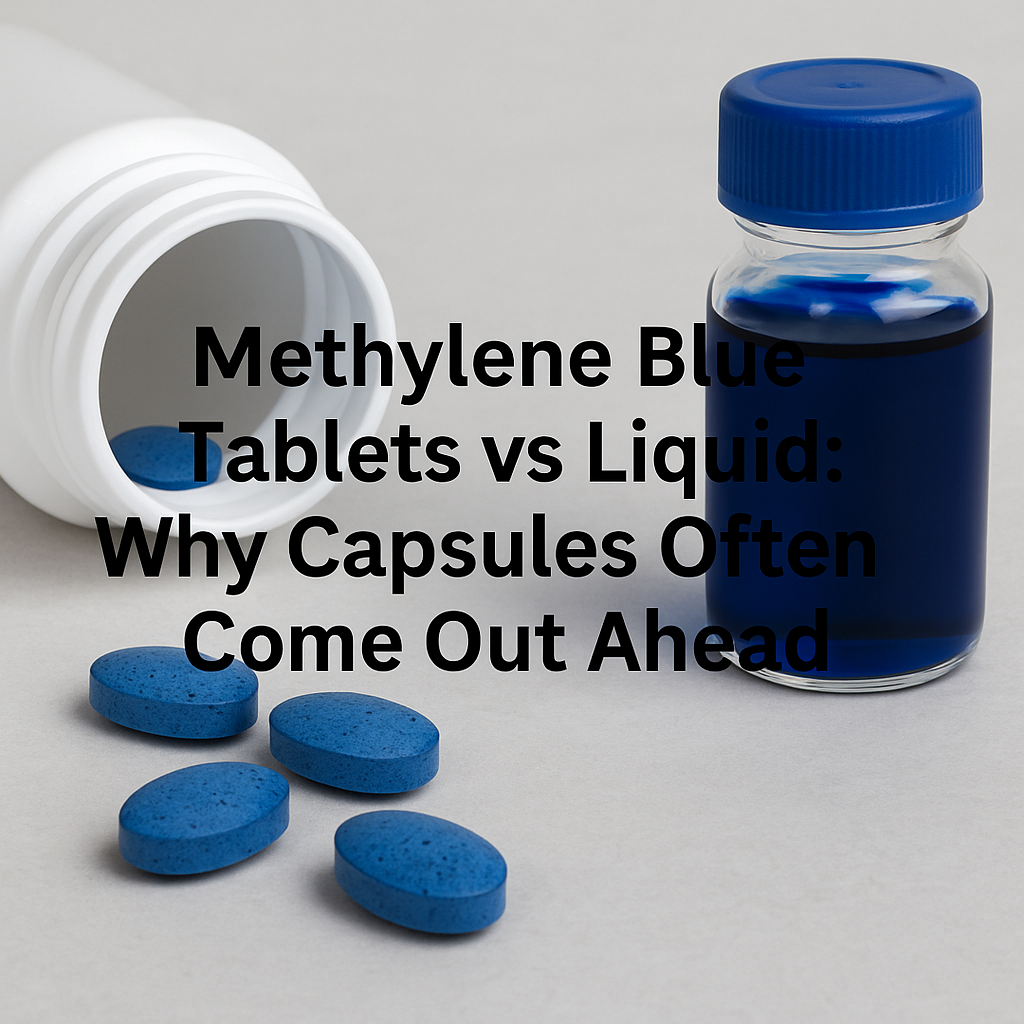
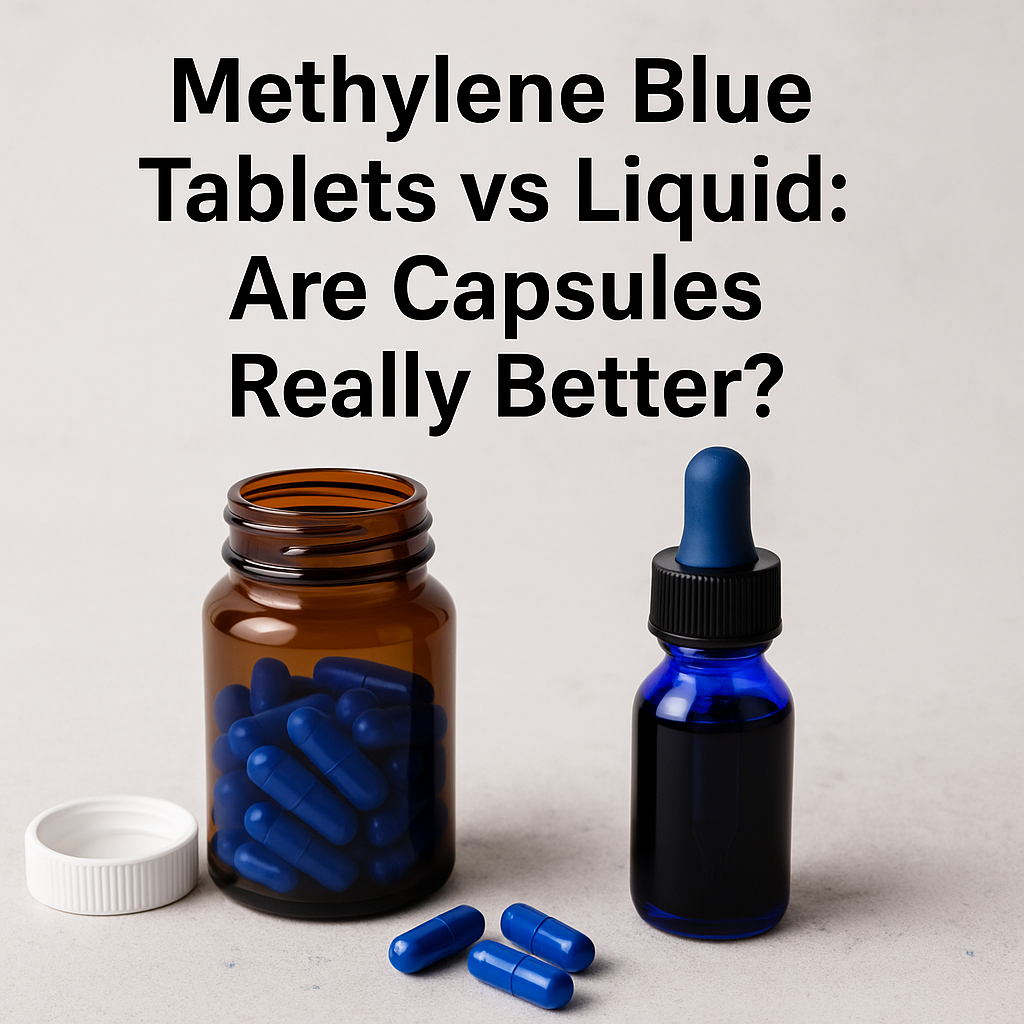
Wondering whether to choose methylene blue tablets or liquid for your protocol? The right format can change everything from taste and convenience to dosing accuracy and travel-friendliness.
While many users find methylene blue capsules or tablets easier to live with than liquid, each form has clear pros and cons. Below, we’ll break down how tablets compare to liquid across the factors that actually matter day to day.
What’s the real difference between methylene blue tablets and liquid?
Both tablets and liquid typically contain the same active compound: methylene blue. The main differences are in delivery, dosing, additives, and user experience rather than the core ingredient.
- Tablets/capsules: Pre-measured solid doses, often in veggie capsules or compressed tablets.
- Liquid: A solution or drops of methylene blue in water or another carrier, measured with a dropper or syringe.
Because the active ingredient is the same, most comparisons come down to how precisely you can dose it, how easy it is to take, and how consistent the experience is over time.
Why many users prefer methylene blue tablets or capsules
For a lot of people, capsules or tablets become the default choice after they’ve tried both. Here’s why.
1. Cleaner, simpler dosing
With liquid, you’re usually counting drops or measuring milliliters, which can vary depending on dropper angle, bottle temperature, or how quickly you squeeze. Tablets and capsules remove that variability:
- Pre-set dose: Each capsule or tablet delivers a known amount of methylene blue.
- Lower risk of user error: No guessing drop size, no squinting at tiny volume markings.
- Easier to log: Tracking intake in a journal or app is straightforward when each pill equals a specific, fixed dose.
If you care about repeatable protocols, titrating slowly, or sharing a consistent routine with a clinician or coach, this simplicity is a major advantage.
2. Less staining and mess
Methylene blue is notorious for staining sinks, counters, clothes, and teeth. Liquids magnify that risk:
- A bumped dropper can splatter blue across your bathroom or kitchen.
- Any spill on hands, clothes, or surfaces can leave stubborn stains.
- Liquid contacting teeth or tongue can cause temporary blue discoloration.
Tablets and capsules are far less messy. Swallowing a capsule with water keeps the dye contained, with minimal contact on teeth and surfaces. For people who care about a tidy routine—or who share a bathroom—this matters more than you might expect.
3. Better portability and travel-friendliness
Travel is where methylene blue tablets or capsules clearly pull ahead of most liquids:
- No liquid restrictions: Tablets and capsules bypass airline liquid limits and security scrutiny.
- Lower breakage risk: Solid forms are less likely to leak or crack in luggage.
- Discreet dosing: You can take a capsule with water anywhere without measuring or using a dropper.
If you’re on the go frequently, capsules or tablets make it far easier to maintain consistency without worrying about spills or confiscation.
4. More neutral taste experience
Liquid methylene blue can have a noticeable taste and can temporarily discolor the mouth. Some users don’t mind; others find it off-putting. Capsules and most tablets largely sidestep these issues:
- Capsules: Typically mask taste almost completely.
- Tablets: Depending on coating, they may still have some taste if they dissolve slowly in the mouth.
If you’re sensitive to strong tastes or textures, capsules are often the most comfortable option.
Where liquid methylene blue can still make sense
Even if methylene blue capsules are more convenient for many people, liquid is not without its advantages. In specific scenarios, it can actually be the better choice.
1. Fine-grained dose adjustments
Liquid formats shine when you need to make very small or gradual dose changes. For example:
- Starting at extremely low amounts and titrating up drop by drop.
- Splitting doses throughout the day in small increments.
- Adjusting for body weight or sensitivity with more nuance than fixed tablet strengths allow.
If precision micro-adjustments are your priority, a well-calibrated liquid with a clear concentration label can be useful—provided you’re comfortable with careful measuring.
2. Flexible administration methods
Some users and practitioners prefer liquid methylene blue when they want non-oral or mixed delivery methods, such as:
- Adding measured drops to a larger volume of water or another beverage.
- Using small amounts in topical or experimental applications under guidance.
In these more specialized use cases, a liquid format offers flexibility that a fixed-dose tablet simply cannot match.
Side-by-side comparison: methylene blue tablets vs liquid
Here’s a practical comparison of how methylene blue tablets or capsules stack up against liquid across key decision points.
Ease of use
- Tablets/capsules: Very easy—just swallow with water. Minimal learning curve.
- Liquid: Requires measuring drops or milliliters accurately each time.
Dosing consistency
- Tablets/capsules: High consistency per dose, assuming quality manufacturing.
- Liquid: Depends on accurate measuring and consistent drop size; more room for user error.
Mess and staining risk
- Tablets/capsules: Low risk; most staining issues come from accidental chewing or breaking capsules.
- Liquid: Higher risk of spills, splashes, and blue staining on skin, clothes, and surfaces.
Portability
- Tablets/capsules: Excellent for pockets, bags, and travel kits.
- Liquid: Less convenient; bottles can leak and are subject to liquid restrictions when flying.
Taste and mouth feel
- Tablets/capsules: Generally minimal taste, especially with capsules.
- Liquid: Noticeable taste and more frequent temporary mouth staining.
Flexibility of dose
- Tablets/capsules: Limited to the strengths available; you can split some tablets, but capsules are not always easy to divide cleanly.
- Liquid: Highly flexible; you can adjust by small increments if you know the concentration.
When methylene blue capsules are usually the better choice
Given all of the above, methylene blue capsules or tablets are typically a better fit if you:
- Want a simple, low-fuss routine you can repeat every day.
- Prioritize clean, consistent dosing with minimal chance of user error.
- Travel frequently or take methylene blue outside the home.
- Dislike the taste or mouth staining that can come with liquids.
- Share a bathroom or workspace and want to avoid staining sinks and counters.
If that describes you, capsules will almost always feel more sustainable and practical in the long run than liquid.
When liquid methylene blue might be worth considering
On the other hand, a liquid form may make more sense if you:
- Need very small or finely adjusted doses that tablets can’t easily provide.
- Work under guidance that specifies drop-based or concentration-based protocols.
- Are comfortable with careful measuring and don’t mind the extra steps.
In those narrower situations, the flexibility of a liquid can outweigh its downsides.
Quality considerations that matter more than format
Whether you choose methylene blue tablets, capsules, or liquid, the quality of the product is at least as important as the format itself. Key points to look at include:
- Intended use and purity: Look for methylene blue that is clearly designated for human use, with details on purity and contaminants.
- Clear labeling: The label should specify the exact amount of methylene blue per capsule/tablet or per milliliter/drop.
- Transparent ingredients: Check for additional excipients, fillers, or solvents and make sure you’re comfortable with them.
- Batch testing and documentation: Many higher-quality brands provide batch or third-party testing information.
These factors influence your experience just as much as whether you choose a capsule or a liquid bottle.
Practical tips for switching from liquid to methylene blue tablets
If you’ve started with liquid and want to move to capsules or tablets, a few simple steps can make the transition smoother:
- Match the dose: Calculate how many milligrams you’ve been using from your liquid and choose a capsule strength that comes closest.
- Consider timing: Keep your dosing schedule (morning, evening, with/without food) consistent while you switch formats.
- Monitor response: Even with equivalent doses, pay attention to how you feel for a week or two after switching.
Most people find that once they move to methylene blue capsules, they don’t want to go back to the extra steps and mess of liquid.
So, are methylene blue capsules really better than liquid?
For the majority of everyday users, yes: methylene blue tablets or capsules are usually better than liquid in terms of convenience, cleanliness, portability, and dosing consistency. Liquid still has a role when extremely fine dose adjustments or non-standard applications are needed, but for a simple, sustainable routine, capsules tend to win.
If you’re comparing options, start by clarifying your priorities—simplicity vs flexibility—and then choose the format that best fits your actual daily life. For most people, that means methylene blue capsules or tablets become the long-term choice, with liquid reserved for more specialized needs.
Thanks for reading our blog.