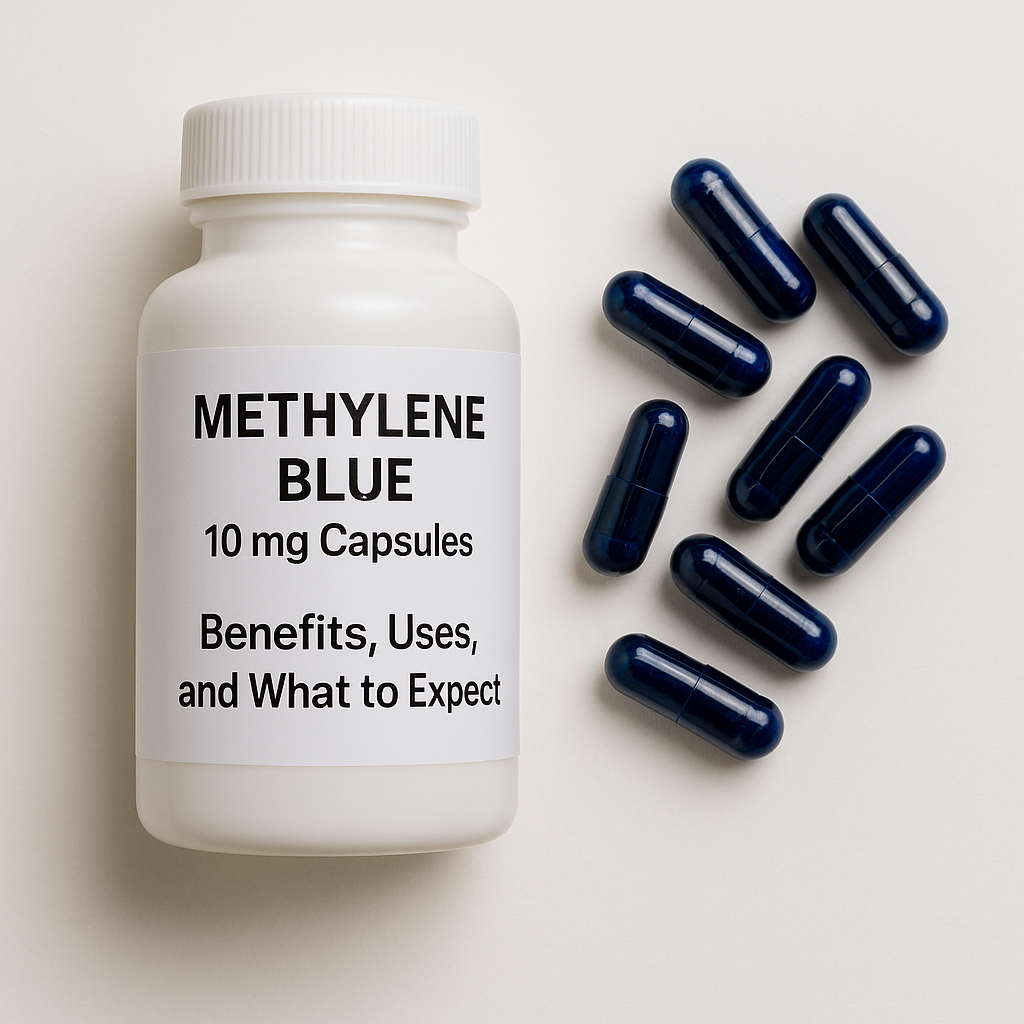
If you’ve heard people talk about sharper thinking, better focus, or “mitochondrial support” from methylene blue, it can be hard to know what’s hype and what’s grounded in real science. Methylene blue is an old compound with some intriguing brain-related effects, but it’s not a magic pill—and it’s not risk-free. This guide walks through the potential methylene blue brain benefits, how it seems to work, and what tradeoffs and cautions you should know.
What Is Methylene Blue, Really?
Methylene blue is a synthetic dye first used in the late 1800s. In medicine, it’s been used for decades in carefully controlled doses to treat conditions like methemoglobinemia (a blood disorder) and as a surgical stain. More recently, it’s attracted interest for its potential effects on brain energy, mood, and cognitive performance.
At a basic level, methylene blue can act as an electron carrier. That means it can participate in the chain of reactions your mitochondria use to make ATP—the energy currency of your cells. Because neurons are so energy-hungry, anything that meaningfully improves mitochondrial function may have noticeable effects on how your brain feels and functions.
How Methylene Blue May Support Brain Function
Most of the proposed methylene blue brain benefits trace back to three big ideas: supporting cellular energy, protecting neurons from damage, and modulating key brain chemicals. Research is ongoing, but here’s what’s being explored.
1. Mitochondrial Support and Mental Energy
Your brain consumes a disproportionate amount of your body’s energy. When mitochondrial function is subpar, people often describe brain fog, sluggish thinking, and mental fatigue. Methylene blue appears to interact with mitochondrial enzymes and the electron transport chain, potentially making ATP production more efficient in certain contexts.
Why this matters in real life:
- Mental stamina: Some people report being able to work on complex tasks longer before feeling drained.
- Sharper focus: When brain energy is more stable, distractions can feel less overwhelming and sustained attention may come more easily.
- Reduced “afternoon crash”: Improved cellular energy could translate into fewer energy dips later in the day, especially during cognitively demanding work.
It’s important to note that these real-world experiences are not the same as large-scale clinical proof. The mechanistic science is promising, but dosage, individual biology, and overall health all change how pronounced any benefit might be.
2. Cognitive Performance and Memory
Another area of interest is methylene blue’s potential effect on cognitive performance—things like memory, processing speed, and learning. In some experimental and early human studies, low doses of methylene blue have been associated with improvements in certain memory tasks and functional brain imaging markers.
Potential benefits people care about:
- Working memory: Holding and manipulating information in your mind (for example, doing mental math or following complex instructions).
- Learning efficiency: Taking in new information and retaining it more reliably.
- Task switching: Moving between tasks without feeling as mentally “sticky” or slow.
In practical terms, these methylene blue brain benefits might show up as remembering names more easily, following technical discussions with less strain, or feeling more mentally “quick” in meetings. But again, the data is still developing, and benefits—if present—are likely to be modest, not superhuman.
3. Neuroprotection and Long-Term Brain Health
Beyond short-term performance, methylene blue has been studied for potential neuroprotective effects. Researchers are interested in how it might:
- Reduce oxidative stress in brain cells.
- Support mitochondrial resilience under stress.
- Influence protein aggregation and other processes implicated in neurodegenerative conditions.
For everyday life, the appeal is obvious: supporting long-term brain health and resilience as you age. While some lab and early clinical work is encouraging, this area is especially complex. No single compound, including methylene blue, can guarantee prevention or reversal of neurodegenerative disease. At best, it may become one tool among many: sleep, nutrition, movement, mental engagement, and medical care still do most of the heavy lifting.
4. Mood, Motivation, and Stress Response
Methylene blue also interacts with several neurotransmitter systems and signaling pathways, including those related to serotonin and nitric oxide. Because of that, there is interest in its potential to influence mood, anxiety, and overall stress response.
Where this might feel relevant:
- You feel mentally flat or unmotivated, even when you’re not physically tired.
- Stress seems to sap your cognitive capacity more than it used to.
- You’re exploring strategies to support mood stability alongside lifestyle changes.
Some early research and case reports suggest possible antidepressant or mood-supportive effects at specific doses and in specific contexts, but this is not yet a mainstream, first-line approach. It should never replace professional mental health care, and it can interact with certain medications (especially serotonergic drugs).
Common Real-World Scenarios Where People Explore Methylene Blue
People curious about methylene blue brain benefits often fall into a few broad groups. Understanding these scenarios helps frame both the potential value and the limitations.
High Cognitive Demand Professionals
Knowledge workers, entrepreneurs, programmers, and students sometimes look at methylene blue as a potential way to stay sharp through long, mentally intensive days. They’re often already paying attention to sleep, caffeine intake, and productivity habits, and are looking for a marginal edge.
What they’re hoping for: more consistent focus across the day, fewer episodes of brain fog, and a small but reliable boost in memory and mental clarity—especially under time pressure.
Midlife Brain Fog and “Slowdown”
People in their 40s, 50s, or beyond often describe subtle changes: it takes longer to recall words, multitasking feels harder, and recovering from poor sleep or stress is more difficult. Because methylene blue is being studied in the context of aging and mitochondrial function, this group is especially interested in its potential to support long-term brain health.
What they’re hoping for: clearer thinking, better recall, and a sense of mental vitality that feels closer to earlier adulthood—without resorting to harsher stimulants.
Biohackers and Experimental Users
There’s also a community of self-experimenters who track detailed metrics—reaction time tests, cognitive tasks, mood logs, and wearables—and explore low-dose methylene blue as part of a broader brain optimization stack. They may combine it with other lifestyle strategies and supplements aimed at mitochondrial health, inflammation, and sleep quality.
What they’re hoping for: measurable improvements in cognitive test scores, subjective clarity, and resilience under cognitive or physical stress.
Key Benefits People Attribute to Methylene Blue
Putting it all together, here are the methylene blue brain benefits most often discussed, along with important caveats.
- Enhanced mental clarity: A cleaner, more focused mental state with less background “noise” or fog, especially during complex tasks.
- Improved memory performance: Better recall of recent conversations, names, and details; potentially smoother learning and retention.
- Greater mental stamina: The ability to sustain attention and problem-solving for longer stretches without feeling as drained.
- Support for brain energy metabolism: By interacting with mitochondrial pathways, methylene blue may help neurons use fuel more effectively.
- Potential neuroprotection: Early evidence suggests it may help buffer neurons against certain types of stress, which could be relevant for long-term brain health.
- Possible mood and motivation support: Through its influence on brain signaling pathways, some users report improved mood and resilience to stress.
These benefits should be viewed as possibilities, not guarantees. Individual responses vary widely, and many of the most enthusiastic reports come from early adopters and small studies rather than large, definitive trials.
Important Limits, Risks, and Tradeoffs
Because methylene blue is often discussed in optimization circles, it’s easy to overlook that it’s a powerful pharmacological compound with real risks at the wrong dose or in the wrong context.
1. Dose Matters—A Lot
Many of the potentially beneficial brain effects of methylene blue appear at relatively low doses. At higher doses, the benefits may vanish or reverse, and side effects become more likely. More is not better.
Potential issues at higher or inappropriate doses can include:
- Headaches, dizziness, or restlessness.
- Digestive upset.
- Changes in blood pressure or heart rate.
- In extreme cases, serious complications such as serotonin syndrome (especially when combined with serotonergic medications) or problems with oxygen transport in the blood.
2. Interactions With Medications and Conditions
Methylene blue is not suitable for everyone. It can interact with a range of medications and underlying health conditions. For example, it can act as a monoamine oxidase inhibitor (MAOI) at certain doses, which is particularly relevant for people taking antidepressants or other serotonergic drugs.
This is why medical guidance is critical: a healthcare professional can review your medication list, medical history, and goals before you consider methylene blue, and help you weigh potential brain benefits against individual risk.
3. Quality and Formulation Concerns
Another practical issue is product quality. Industrial or laboratory-grade methylene blue may contain contaminants that are not appropriate for human use. If someone does use methylene blue under medical supervision, pharmaceutical-grade or appropriately formulated products are typically preferred.
Look for clear information on:
- Purity and testing.
- Exact concentration and dosing instructions.
- Intended use (e.g., research vs. medical or supplemental contexts).
4. The Bigger Picture Still Matters More
Even where methylene blue brain benefits are real, they sit on top of the basics: sleep, nutrition, movement, stress management, and meaningful mental engagement. Poor sleep, chronic stress, and inactivity can easily outweigh any incremental gain from a single compound.
For most people, the smartest strategy is to treat methylene blue—if used at all—as a possible advanced tool, not a foundation. Addressing lifestyle and medical fundamentals first usually delivers the biggest, most reliable improvements in brain performance and long-term brain health.
How to Think About Methylene Blue in a Brain Health Strategy
If you’re drawn to the idea of better brain energy, sharper focus, and long-term cognitive resilience, methylene blue can be an intriguing topic to explore. But the most productive way to think about it is as part of a broader framework, not a standalone solution.
Clarify Your Goal First
Different goals imply different approaches:
- Short-term cognitive performance: You might be focused on exam periods, product launches, or creative sprints. Here, sleep optimization, light exposure, and time-blocking often deliver enormous benefits before any compound is considered.
- Long-term brain health: You’re thinking in decades, not days. Diet quality, metabolic health, blood pressure, and social and cognitive engagement all have strong evidence behind them and should be prioritized.
- Mood and resilience: If mood, anxiety, or burnout are central concerns, professional mental health support is the right starting point. Any discussion of methylene blue should happen inside that relationship, not outside it.
Have an Informed Conversation With a Professional
Because methylene blue is pharmacologically active and can interact with medications, self-directed experimentation carries real risk. If you’re seriously considering it, discuss:
- Your current medications and supplements.
- Any cardiovascular, psychiatric, or metabolic conditions.
- Your specific cognitive or mood goals.
- Evidence-informed dosing ranges and monitoring plans, if appropriate.
This kind of structured, informed approach gives you the best chance to capture potential methylene blue brain benefits while minimizing downside.
Bottom Line: Promising, but Not a Shortcut
Methylene blue occupies an unusual space: it’s an old medical dye with modern interest as a brain and mitochondrial support compound. The science behind its mechanisms—especially around cellular energy and neuroprotection—is intriguing, and early work suggests it may offer benefits for mental clarity, memory, and long-term brain resilience in some contexts.
At the same time, it’s not a casual supplement. Dose, purity, drug interactions, and individual health status all matter. The most realistic way to view methylene blue is as a potentially useful, advanced tool to explore carefully with professional guidance, after you’ve built a strong foundation of sleep, nutrition, movement, and stress management.
If you stay grounded in that perspective, methylene blue can move from internet hype to a thoughtful, evidence-informed part of your overall brain health strategy.
Thanks for reading our blog.